
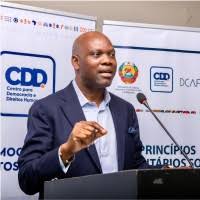
A reflection on solidarity, civic participation, whistleblower protection, and the role of civil society in Mozambique’s democratic consolidation.
What happened in Mozambique in the days following Adriano Nuvunga’s conviction deserves attention not only from a legal and political perspective, but also from a sociological and human rights perspective.
Within a matter of days, more than 23,000 citizens spontaneously mobilized to raise 1,075,000 meticais to cover the one-million-metical compensation imposed on the Executive Director of the Centre for Democracy and Human Rights (CDD)
.The figures are remarkable. But what makes this episode truly extraordinary is its nature.
There were no major publicity campaigns. No institutional funding. No wealthy benefactors driving the effort. The movement emerged organically, spreading through social media, community networks and personal contacts, mobilizing thousands of ordinary citizens across Mozambique and throughout the diaspora.
There are moments when a society reveals what it truly believes—not through opinion polls, official speeches or institutional statements, but through its actions. The mobilization around Adriano Nuvunga is one such moment. By its spontaneous nature, the speed with which it emerged and the scale it achieved, the phenomenon has no known precedent in Mozambique’s recent history.
What is perhaps most remarkable is not the amount raised, but how it was raised. The more than one million meticais did not come from a handful of businesspeople, politicians or wealthy donors. They came from thousands of ordinary Mozambicans: market vendors, students, civil servants, motorcycle taxi operators, small traders, unemployed youth and countless other citizens. It is precisely this broad-based participation that transforms the campaign into a political and social phenomenon of profound significance.
It would be a mistake to interpret this mobilization merely as an emotional reaction to a court ruling. Something deeper is at play. For more than two decades, Adriano Nuvunga has occupied a unique place in Mozambique’s public life. Few civil society leaders have exercised such sustained scrutiny of political power during the administrations of Armando Guebuza and Filipe Nyusi.
Through the Centre for Public Integrity (CIP) and later through the Centre for Democracy and Human Rights (CDD), Nuvunga became one of the country’s most prominent voices exposing corruption, poor governance, human rights violations, lack of transparency and electoral integrity challenges.
It is important to recall that the origins of this case lie in allegations that Albino Forquilha had allegedly received 219 million meticais in exchange for influencing what became known as the “electoral truth” surrounding Mozambique’s disputed 2024 elections. Upon receiving the information, Nuvunga submitted it to the competent authorities for investigation.
Throughout the proceedings, however, he refused to disclose the identity of the source who provided the information. He did so in defence of a principle fundamental to democratic societies: the protection of sources and whistleblowers. In environments marked by fear, intimidation and the risk of retaliation, whistleblower protection is essential to fighting corruption, strengthening accountability and safeguarding the public interest.
From a human rights perspective, the case extends far beyond Adriano Nuvunga as an individual. It touches on fundamental principles relating to freedom of expression, access to information, whistleblower protection and the role of civil society in promoting transparency and accountability.
Yet the story does not end there.
As the campaign expanded, it became clear that the funds raised would exceed the original target. Given that the appeal process suspends enforcement of the ruling, part of the surplus was directed to families who symbolize some of the deepest wounds of Mozambique’s recent political crisis.
Among the beneficiaries was the widow of Elvino Dias, lawyer and legal adviser to Venâncio Mondlane, who was assassinated in Maputo on 19 October 2024. Support was also extended to the daughter of Paulo Guambe, a political figure killed in the same attack.

Part of the funds was allocated to the widow of Mano Shottas, whose death became one of the symbols of the human cost of Mozambique’s post-election crisis.
Another portion was provided to the wife of Jota Pachoneia, a social activist currently detained in Nampula Provincial Prison.
This evolution of the campaign reveals an even deeper dimension of the phenomenon. What began as a response to a judicial ruling became a broader expression of solidarity among citizens affected, directly or indirectly, by political violence, repression and restrictions on civic participation.
The episode also reveals something important about the evolution of citizenship in Mozambique. In a country often described as characterized by political apathy, fear or disengagement from public affairs, the mobilization demonstrated precisely the opposite. It revealed a significant reserve of social trust that can be activated when citizens identify a cause they perceive as just and worthy of support.
By contributing small amounts, thousands of citizens were not simply helping to pay a potential compensation award. They were affirming the importance of freedom of expression, civic participation, public accountability, whistleblower protection and the defence of the public interest.
Regardless of the outcome of the appeal before the higher courts, one fact has already entered the history of this case. A court convicted an individual. Society responded with 23,706 acts of solidarity.
In doing so, it transformed an individual conviction into one of the most significant demonstrations of active citizenship, public trust, human rights advocacy and democratic solidarity witnessed in Mozambique since independence.
It may still be too early to fully understand the long-term implications of this episode. But one thing already seems clear: the Nuvunga Case has ceased to be merely a legal proceeding. It has become a milestone in the history of Mozambican civil society and a powerful reminder that when citizens believe in a cause, solidarity itself can become a force for democratic participation.




Leave feedback about this