
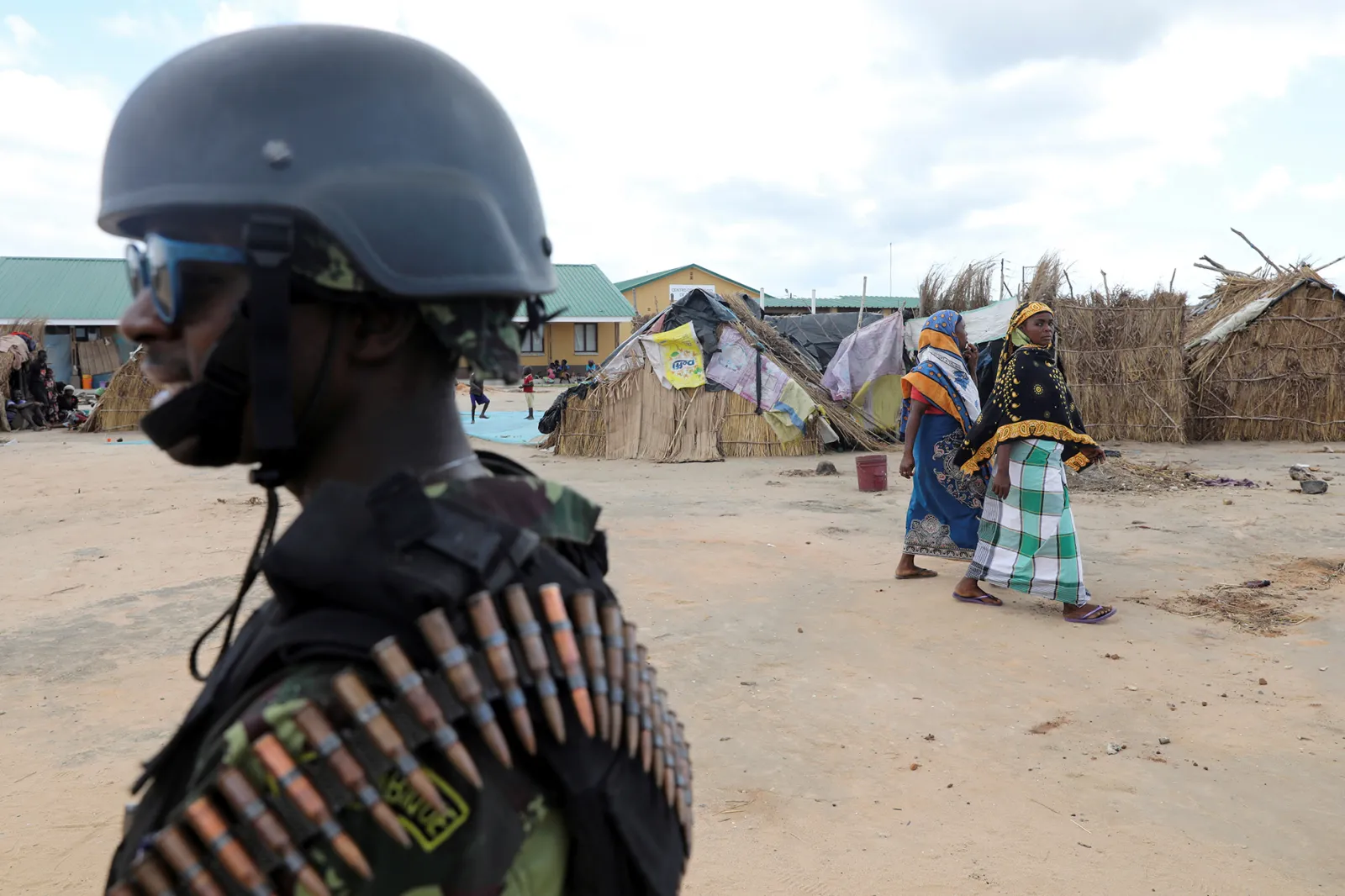
“While military actions have contained territorial expansion, lasting solutions require dialogue.”


Ongoing attacks by Islamic State Mozambique (ISM) in the northern province of Cabo Delgado are forcing hundreds of thousands of families from their homes, deepening a humanitarian crisis that has ground on for close to a decade.
At least 300,000 people have been displaced by the jihadist violence since July, including more than 100,000 following a spate of attacks late last year. The surge has pushed many families to flee districts previously considered relatively safe, further stretching humanitarian operations at resettlement centres that already operate beyond capacity.
Figures from the Armed Conflict Location and Event Data (ACLED) puts the death toll from the insurgency at 6,418 since 2017. In the final week of January and first week of February alone, eight “political violence events” were recorded, including clashes between ISM and the security forces in Mocímboa da Praia and Macomia districts.
But beyond the death toll is the profound social and economic dislocation. Since 2017, when the conflict began, it has displaced 1.3 million people in Cabo Delgado, according to provincial authorities. While more than 661,000 have returned home voluntarily, nearly 429,000 remain in 57 displacement camps, while many others have settled with families and friends.
The humanitarian cost
In Chiúre district, and in the provincial capital, Pemba, families speak of loss, constant fear, and growing difficulty in securing food, shelter, and protection.
At the Megaruma resettlement camp in Chiúre, uncertainty dominates daily life. Maria Ali (not her real name) was displaced from Macomia district after a series of attacks in early December.
“We left at night with nothing but the clothes we were wearing,” she told The New Humanitarian. “The children were crying and didn’t know where we were going. Here we are alive, but life is very difficult.”
Humanitarian assistance is irregular and insufficient. “Sometimes we go two or three days without receiving flour,” she said. “When it arrives, it’s not enough for everyone. There is no work, and we have no way to support our children.”
João Mussa, a farmer who lost his land to the conflict, said fear has followed him even to the displacement camp. “Even here, we sleep in fear,” he explained. “We hear rumours of attacks and don’t know how long we will be safe.”
Overcrowding, he added, is worsening health and social conditions. “Too many people are cramped in a small space,” said Mussa. “Children get sick easily, and the health post is far away.”
At the Maringanha resettlement site on the outskirts of Pemba, security is relatively stable, but the humanitarian challenges remain severe.
Amina Saide, displaced from Muidumbe district, said the city offers a sense of protection but does little to ease her trauma.
“Here we don’t hear gunfire, but we carry everything we saw,” she noted. “We lost relatives and our homes. This doesn’t leave your mind.”
Many families depend almost entirely on external aid. “Without support from organisations, we cannot survive. We don’t have land to farm, and the cost of living in Pemba is high,” said Saide. She fears that reductions in humanitarian assistance could push families back towards unstable areas “because life here is also very hard”.

Mozambique: A case study of growing need and global aid cut confusion
What does all this talk of humanitarian reset, deprioritisation, and accelerated transition actually mean for people in crisis-affected communities?
A military stalemate
Despite years of counter-insurgency operations, the conflict shows no sign of resolution.
The government initially turned to South African and Russian mercenaries to halt ISM’s expansion – without success. In 2021, it agreed to simultaneous interventions by the regional Southern African Development Community Mission in Mozambique (SAMIM) and Rwandan forces.
But SAMIM withdrew under funding pressures in 2024, and Rwanda has warned it may follow suit if European Union financing is not renewed in May.
Borges Nhamirre, a researcher at the Institute for Security Studies, said the combined interventions have recorded some positive results. “The operations have largely confined ISM to a restricted territory, preventing expansion beyond northern and central Cabo Delgado,” he told The New Humanitarian.
Local militias have also been effective in protecting communities and preventing insurgents from establishing permanent footholds in key districts such as Macomia, Mudumbe, and Balama.
Yet those successes have not been exploited.
Mozambique “achieved important military gains with external support, but failed to consolidate them”, Abdul Machava, a security analyst, told The New Humanitarian. “There were moments when territorial control was restored, but decisive steps were not taken to prevent insurgents from reorganising.”
ISM, Machava noted, has adapted: “The group shifted from territorial control to targeted attacks, [which have had] a strong psychological and media impact.”
The limits of foreign intervention
Rwandan forces have become a central pillar of the security response, but questions are mounting over their mandate.
They have focused primarily on securing the multi-billion dollar liquefied natural gas (LNG) infrastructure belonging to the French multinational TotalEnergies – which declared force majeure in 2021 but resumed construction work last year.
“The LNG projects have never been directly attacked despite the ongoing conflict,” said Nhamirre. “The troops also maintain security perimeters around key towns like Palma and Mocímboa da Praia.”
But community attitudes, initially positive, have begun to shift. “By late 2024, perceptions began to change due to a perceived decline in operational intensity, with insurgents increasingly observed operating within areas under Rwandan responsibility,” said Nhamirre.
Sheila Nhancale, a researcher at Human Rights Watch, echoed those concerns. She acknowledged the Rwandan presence “has helped to stabilise certain areas previously controlled by insurgents”, but warned that a predominantly military approach, without strong civilian oversight and accountability, risks undermining long-term human security.
“Effectiveness,” she said, “should be measured not only by territorial gains but by tangible improvements in the safety and well-being of communities.”
The roots of insurgency
Despite ISM’s links to regional and international jihadist movements, “the rebellion in Mozambique has its own characteristics as a local guerrilla movement,” Machava stressed.
For analysts and civil society actors working in Cabo Delgado, the persistence of violence points to failures that no military operation alone can fix.
“Violence cannot be analysed only from an exclusively military perspective. There is a deep history of marginalisation, social exclusion, and lack of opportunities for young people.”
Abudo Gafuro, a representative of the local non-profit Kuendeleya Association, said the worsening displacement reflects unresolved structural problems.
“Violence cannot be analysed only from an exclusively military perspective,” he told The New Humanitarian. “There is a deep history of marginalisation, social exclusion, and lack of opportunities for young people.”
Many communities feel excluded from the benefits of Cabo Delgado’s vast natural resources. “People see wealth leaving their land, but remain without schools, hospitals, or jobs,” said Gafuro. “That resentment creates fertile ground for recruitment by armed groups.”
Cabo Delgado’s complex ethno-linguistic diversity has historically complicated social cohesion. “There is a perception that some [politically connected] groups benefited more than others over time,” Machava noted. “This sense of injustice is a powerful fuel for the conflict.”
The government has responded to the concerns over Cabo Delgado’s structural marginalisation. ADIN, a World Bank-backed development agency, operates in the province, but critics argue that it is staffed largely with technocrats from the south and operates in a top-down manner that fails to reflect local realities. Its long-term timelines, analysts point out, are ill-suited to a crisis demanding urgent action.
The case for dialogue
With the military option yielding limited results after nearly a decade, there is growing pressure to consider alternatives. Dialogue sits at the top of many analysts’ lists, but its prospects remain deeply uncertain.
Nhamirre argues that dialogue is not only viable but historically validated. “Engaging communities helps identify grievances that contribute to [people’s] vulnerability to recruitment by insurgent groups,” he explained.
“Historical conflicts in Mozambique, including the national liberation struggle and the RENAMO insurgency, demonstrate that dialogue has been the most successful path to resolution,” he added.
It’s a view shared by Gafuro. “As long as social and economic causes are not addressed, displacement will continue, even if there are temporary military gains,” he warned.
However, there are no publicly known channels of communication between the government and ISM. Whether such dialogue is even possible with a group that holds strong ties to Islamic State, however localised its character, remains an open and deeply contested question.
As displacement continues to rise, uprooted families live between hope for peace, and fear of renewed attacks. Maria Ali told The New Humanitarian she wants to return home, but not until it is safe. Mussa, the farmer, is less sure security will ever be fully restored.
Nhamirre argues that peace is a long-term endeavour.
“While military actions have contained territorial expansion, lasting solutions require dialogue, community engagement, and addressing structural issues that leave populations vulnerable,” he said.
This article is published in collaboration with Egab. Edited by Obi Anyadike.
This article is published in collaboration with Egab. Edited by Obi Anyadike.




Leave feedback about this