
The Fall
I should have died when I was nine. The memory has remained vivid all my long life, and my escape, as I look back, seems evermore extraordinary.
Good fortune or fate—I still can’t say.
I remember the brown water and the cloud of bubbles surrounding me as I sank. When I surfaced, my hands searched instinctively for something to hold, but there was only the smooth side of the tied-up boat and the rough, cut-stone wall of the quay. I pushed my palms against them both to keep afloat, but the force pushed the boat outward, stretching its mooring lines tight. I was above water but knew instinctively I would quickly slip back under.
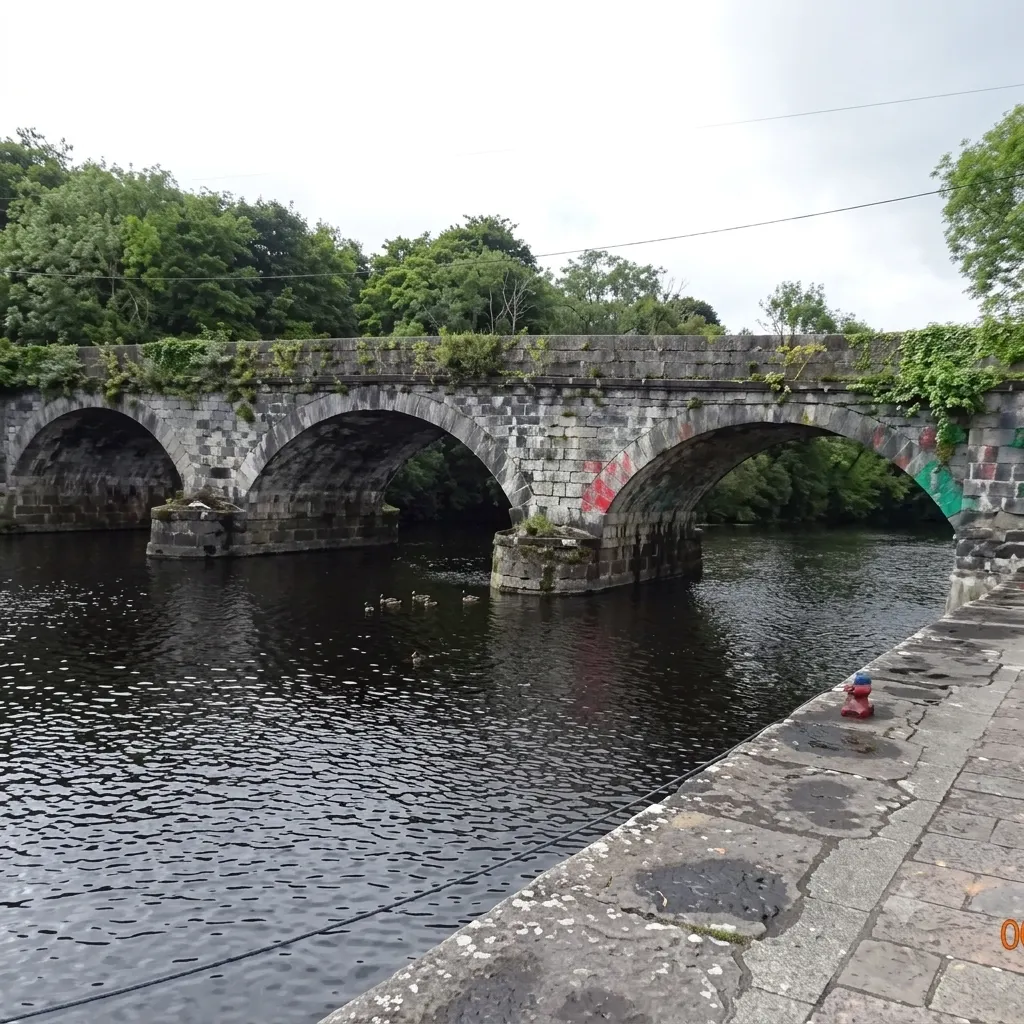
Facing upstream toward the five-arched bridge, I screamed.
I had been fishing on the quay directly downstream; our family house sat just on the other side of the bridge. I never understood how I fell. I had pushed that boat away from the quay wall to make room to fish a hundred times before. Perhaps I had grown careless, or perhaps the stone was slick from recent rain.
The Logic of Luck
Since I started to think about these things, I have never believed that our destinies are mapped out like a signposted road. Yet, it is incontestable that some people carry more good fortune than others.
The idea that individual fate on this planet is micromanaged by God in an immense universe seems impossible to me—though my mother, who was deeply religious, undoubtedly called my survival a miracle. Whatever it was, exceptionnel luck was on my side.
Our family lived on the banks of an upper Shannon tributary. In those days, the river was quiet, used mostly by the occasional summer cruiser travelling from downriver. It was long before boats for hire appeared and changed everything.
My family was responsible for the locks a short distance upstream, where, along with a weir and indeed the bridge helped to make the upper Shannon river more navigable.
All these works were carried out by the English colonisers during the famine times of the mid 19th century when one million Irish died of starvation and another million emigrated.
 |
We grew up around the water. My father owned a lovely rowboat named Bluebird, which he took out on summer Sundays to fish lough Key taking me and sometimes a neighbour with him. But the boat I fished beside, when I fell, belonged to a shopkeeper in the nearby town. It sat moored at the quay so long that green algae sprouted along its darkened hull beneath the waterline. The algae attracted perch, which I fished for using a reel-less bamboo rod, a length of line, a hook, and a worm.
Life moved slowly there. The unpaved country road across the bridge saw little traffic: a farmer’s cart drawn by a donkey or horse on twice-a-week creamery days, turf loads in June and September, a solitary cyclist, or the very rare car.
Intersecting Paths
I don’t know how many times I screamed. My outstretched arms were tiring. Then, a face I didn’t recognize appeared over the bridge’s stone parapet. Someone had heard me.
A farmer from a village two miles downriver—taking a road he almost never used—was cycling across the bridge at that exact moment. Seeing me, he abandoned his bike and ran down the steps toward our house.
Good fortune smiled a second time: it was a Wednesday.
Wednesday was the only weekday my father was at home. Other days – except Sundays – he was away on his insurance rounds. But on Wednesdays, he sat at the large, polished wooden desk in our kitchen-cum-living room, entering weekly accounts into a massive ledger in pounds, shillings, pence, and farthings.
I was nine years old, the second eldest of six – five girls and one boy, me. Neither my mother nor any of us could swim. With only a thin wire fence and a simple latch gate separating our front door from the river fifteen yards away, it remains incredible that none of us had drowned. My father was a strong swimmer, but he was a busy man—balancing his business, a wonderfully kept fruit and vegetable garden, and his health. He was already suffering from the leukaemia that would take him about a year later. Teaching us to swim simply wasn’t a priority.
 |
The Rescue
Suddenly, my father appeared above me on the quay wall, then vanished. Some seconds later he returned, lowering a tree branch down to me. I made a desperate, violent grab for it, missed, and went under.
When I broke the surface again, disoriented and choking, the boat had drifted back, squeezing me against the rough stone. Panic set in. I was about to go under for the third time when my father slid down the quay wall into the water beside me. Terrified, I tried to climb onto his shoulders and head to escape the water. I still remember his calm voice as he tried to soothe me.
How I finally got out is lost to memory. Did my father swim with me to the stone steps on the other side of the bridge? Did the farmer lean over the quay wall to hoist me up as my father lifted me? Did my mother play a part? Those details have dissolved with time.
I only remember being placed in a tub of hot water, wrapped in a heavy blanket, shivering from cold and shock while my mother comforted me. Yet, to my own surprise now, I was back on that quay fishing again just a day or two later.
 |
Echoes
Did it leave lasting scars? Perhaps.
To this day, the thought of suffocating in water terrifies me. Years later, reading about the writer Virginia Woolf walking into a river with her pockets full of stones to end her life, a cold shiver ran through me. I could never imagine choosing water.
Donal Conlon is free today. But if you enjoyed this post, you can tell Donal Conlon that their writing is valuable by pledging a future subscription. You won’t be charged unless they enable payments.




Leave feedback about this