By Zitamar News • 16 Apr 2026
The fuel shortages this week in Maputo and other cities may look like an inevitable symptom of the global energy supply shock caused by the US and Israeli attacks on Iran. But Mozambique’s crisis is not quite what it seems. Beneath the surface, it is exposing a more fundamental constraint in the country’s economy.
At the heart of the crisis is a foreign exchange squeeze that is now biting into essential imports. Fuel distributors must secure bank guarantees, typically via letters of credit, in order to release fuel delivered to Mozambican ports. Yet commercial banks, facing a shortage of foreign currency, are struggling to provide those guarantees. The result is a bottleneck at the point where fuel should be entering the domestic market: cargoes arrive, but cannot be released at scale.
This is not a marginal technical issue. It is a systemic constraint. Mozambique’s import model, coordinated through Imopetro, effectively centralises risk: when financing fails, it fails for everyone at once. The system is efficient in normal times, but brittle under stress.
There is, of course, a broader context that cannot be ignored. Global fuel markets are under strain, with supply disruptions and geopolitical tensions tightening availability and pushing prices upward. Mozambique is not insulated from this. In a constrained global market, smaller and less liquid buyers inevitably find themselves at a disadvantage.
But this only sharpens the underlying problem. Mozambique is not simply failing to secure fuel because there is less of it in the world. It is struggling because, in a tighter market, access depends even more heavily on financial credibility and ready access to foreign currency.
Major traders will still move product. The question is to whom. In that competition, the ability to issue guarantees, mobilise dollars quickly, and absorb price volatility becomes decisive. It is precisely here that Mozambique is weakest. What might, in another country, register as higher prices is instead translating into physical shortages.
Compounding this is the structure of the market itself. State-linked Petromoc appears able, in practice, to access supply on more flexible terms than private distributors, benefiting from the implicit guarantee of the sovereign. That may allow some fuel to continue flowing, but it also distorts the market and cannot compensate for a broader financing gap. Emergency measures allowing wider access to Petromoc stocks may ease pressure at the margins, but they do not address the underlying constraint.
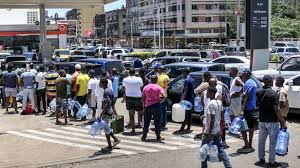
Nor is this purely a supply story. Price differentials with neighbouring countries have created strong incentives for arbitrage, drawing fuel out of Mozambique to higher-priced regional markets. In parallel, signs of panic buying are emerging, particularly in Maputo, as consumers and businesses respond rationally to perceived scarcity. Both dynamics amplify the squeeze on available stocks, even if they are not its root cause.
The policy temptation, as ever, will be to treat the symptoms. Injecting emergency foreign currency into the system may provide temporary relief, and political pressure for such a move is likely to grow. But this risks reinforcing the very distortions that have contributed to the problem, including privileged access and weak allocation mechanisms.
The more uncomfortable question is whether Mozambique is entering a period in which such constraints become structural rather than episodic. If so, fuel queues are not an anomaly. They are an early warning.