

In January 2025, Peruvian journalist Gastón Medina was shot and killed in the city of Ica. He spent his career standing up to the corruption plaguing his region — but nearly two years after his brutal death, the wrongdoing he exposed has been swept under the rug. Although the alleged perpetrators of his murder have been arrested, those who ordered the killing remain at large, with serious suspicions surrounding Congressman Carlos Zegarra.
Credit: Mélody da Fonseca
- A current member of Congress and former advisor to the regional governor of Ica, Carlos Zegarra is one of the main suspects in Gastón Medina’s murder. Though he is named in the court file, the public prosecutor’s office has reportedly summoned him only as a witness.
- Medina exposed Zegarra’s fraudulent purchase of an apartment, which could have motivated his assassination.
By Emmanuel Colombié and Katherine Ayarza (Epicentro TV)
26 novembrer 2026
A burst of gunfire, blood, screams. On the morning of Jan. 20, 2025, in the medium-sized city of Ica, west-central Peru, journalist Gastón Medina was returning home from a meeting at the local university to meet his mother, partner and 10-year-old son.
Before he could step through his front door, a helmeted man on a motorcycle emerged from around the corner, opened fire on him with 11 bullets and fled. Struck in the heart and aorta, Medina didn’t stand a chance. He was rushed to the nearest hospital, where he succumbed to his injuries a few hours later.
The murders of three more Peruvian journalists followed later in 2025, a death toll unseen in the country for over 30 years. Outrage over Medina’s killing flooded the department of Ica and spread nationwide. Forbidden Stories and its Peruvian partner Epicentro TV traveled to the area in July 2026 to shed light on the assassination and continue investigating the stories that cost the reporter his life.
With his large build, piercing gaze and unmistakable, penetrating voice, 60-year-old Medina was one of Ica’s most charismatic and renowned journalists. For more than three decades, he spoke out against corruption.
Medina’s career path was unique, spanning entrepreneurship, journalism and politics. Born in Ica in 1964, he moved to Lima in the 1980s, where he first ventured into media as a technical operator for Radio Omega and as a show host at Radio Panamericana. He went by the nickname “Lobo” — “the wolf” — and later “DJ Wolfie,” conducting interviews about rock music and helping to organize major concerts, including one featuring the French band Indochine in 1988.
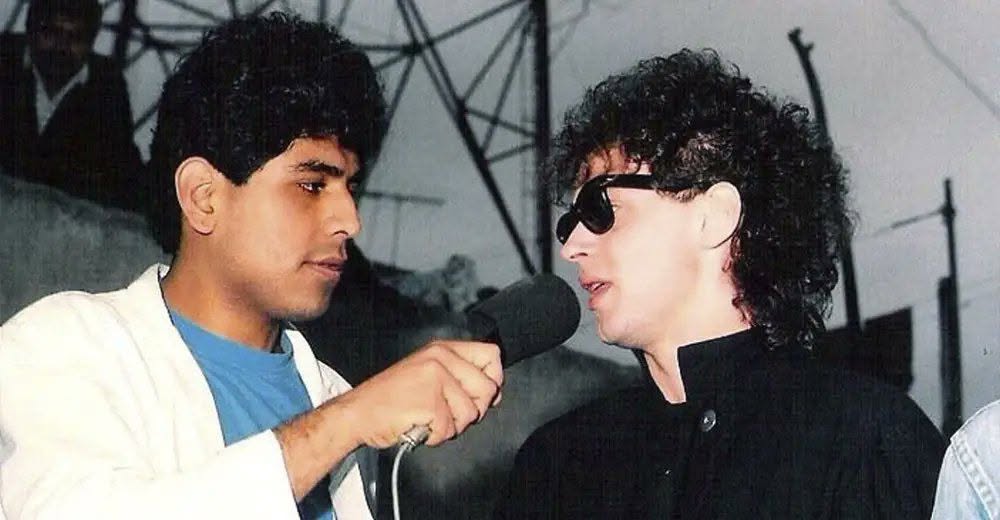
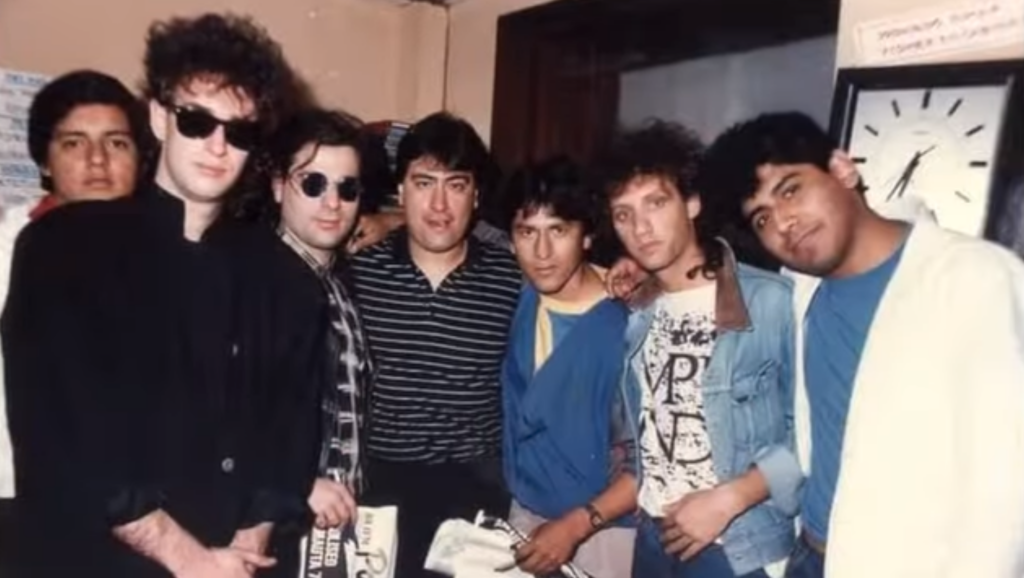
Gastón Medina working as a radio host in Lima in the 1980s (Credit: Facebook/La Historia de Ica).
In 1991, Medina returned to Ica, and with financial support from the family of journalist Pilar Hernández — his new wife and business partner — he invested in radio and television stations. “He had his own businesses,” said his friend and collaborator Pepe.* “In Chinca, Pisco, Nazca, Palpa, Marcona. So we often went to visit his radio and television networks.”
One of them, which Medina named Cadena Sur — “Southern Network” — broadcast in Ica and several municipalities in the department. It would be his main media endeavor from 1995 until his assassination last year.
Cadena Sur, Medina’s life work
At Cadena Sur, Medina gradually refined his distinctive and outspoken style. He gathered information directly from a vast network of sources and contacts, which he broadcast and commented on for hours on air, with little time to spare for more in-depth reporting.
Medina hosted a daily morning show called Gastón en la Radio, followed by a television program filmed at his studios in the heart of Ica. Solo on the air, he analyzed local news, unreservedly denouncing corrupt officials and their ties to organized crime. His scathing critiques were posted and widely shared on his and Cadena Sur’s social media accounts, particularly on TikTok, where he gained a new audience. His programs also provided an outlet for citizen complaints, with listeners flocking to him for help.
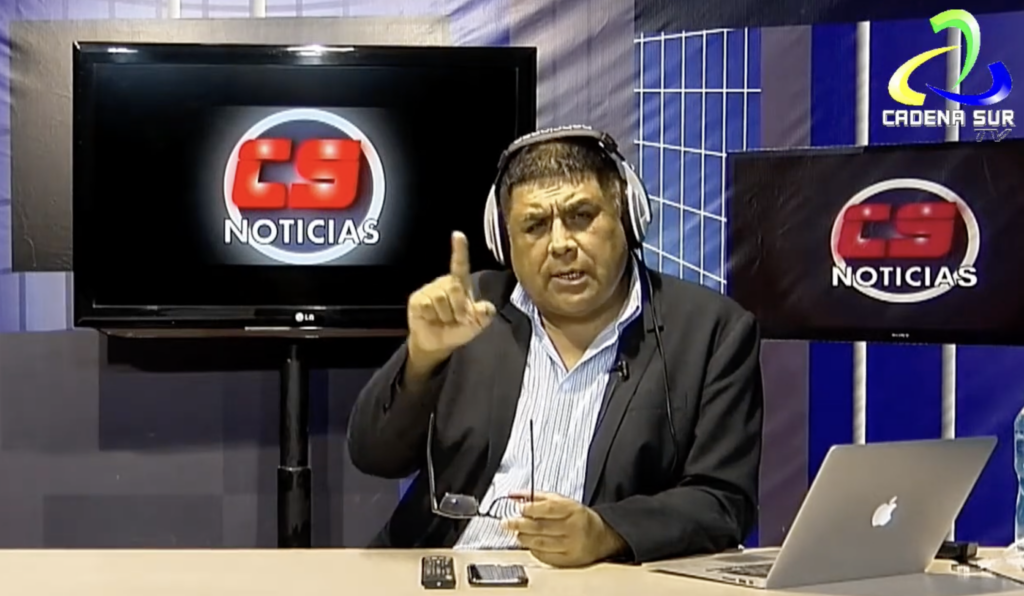
Gastón Medina hosting his show in the studios of the media outlet Cadena Sur (Credit: Forbidden Stories screenshot / YouTube @Cadena Sur).
Medina’s growing popularity fueled his ambition. Spurred on by his supporters and a sense of public duty, he ran for regional governor of Ica in 2010 and 2018 and for a seat in Congress in 2011 and 2020, campaigning on a populist and anti-corruption platform. He was never elected. Instead, Medina went on to devote all his time to journalism.
After separating from his wife, he met Nathalie Caico, who would become his last partner and the mother of his son. Forbidden Stories and Epicentro TV spoke with her in Ica. “He did a good deed every day, before entering politics and after leaving it,” she said.
Medina’s constant media presence, and above all his direct style, would earn him a barrage of attacks and enmities over time. Rarely has a journalist in Peru faced so many threats and acts of intimidation.
“The only way to shut me up is to kill me”
In October 2020, Mónica Guillén, a politician and the wife of then-regional governor Javier Gallegos, filed a complaint against Medina, convinced that he was running a troll factory from his studios to smear her. The Ica public prosecutor’s office and police raided the Cadena Sur studio.
“They barged in, shoved Gastón aside, and in minutes, police officers were everywhere,” recalled Hernández, who was there at the time. “An officer grabbed me and twisted my arm. They treated us as if we were criminals … All the team’s computers and phones were confiscated.”
That day, the police shut down the transmitters, interrupting all of the station’s programs. Radio silence.
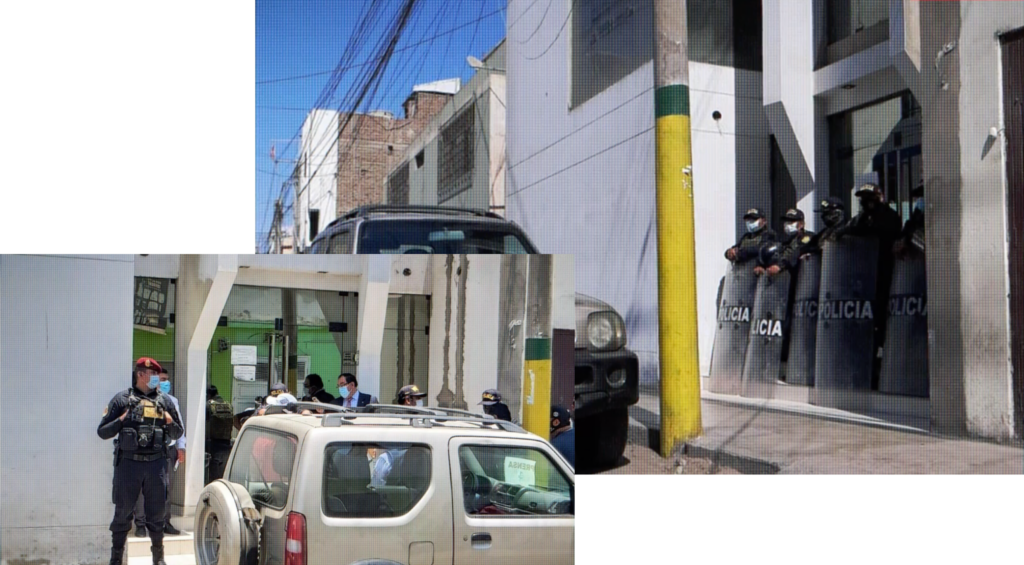
Raid carried out by the Prosecutor’s Office and the police in Ica (Credit: La Lupa).
It was the beginning of a long ordeal for Cadena Sur. On Feb. 22, 2022, after Medina released another exposé on Gallegos’s and Guillén’s corruption, a funeral wreath was left in front of the studio, accompanied by the message, “Gastón, you’re going to die,” and a .38-caliber Smith & Wesson bullet.
On July 25, 2022, feces and red paint were thrown at the studio’s door. Three months later, the threats continued. On Sept. 1, a dead dog appeared in front of the entrance. On Sept. 13 of the same year, a homemade bomb exploded in the middle of the night, shaking the offices and forcing the editorial staff to install a reinforced door. Forbidden Stories was able to visit the studio, which is still in operation. The bullet-riddled facade still bears the scars of those years of persecution.
A turning point came on March 20, 2023. During a live broadcast, Medina called a notorious local criminal and former prisoner, Víctor Mere Huamaní — alias “El Gato,” or “the cat” — who described an exchange he’d had with Carlos Zegarra, then an advisor to the regional governor. “Carlos Zegarra says he’s going to finish you off,” El Gato told Medina.
Stunned, the journalist played voice recordings of the conversation between the two men on a loop, confirming their sinister plan. El Gato changed his story a few months later on the national program Cuarto Poder — one of Peru’s most-watched Sunday shows — claiming he had faked the recordings. On March 3, 2025, less than a month and a half after Medina’s murder, he, in turn, was executed by hitmen during a party in Ica. They made sure to steal his phone before disappearing.
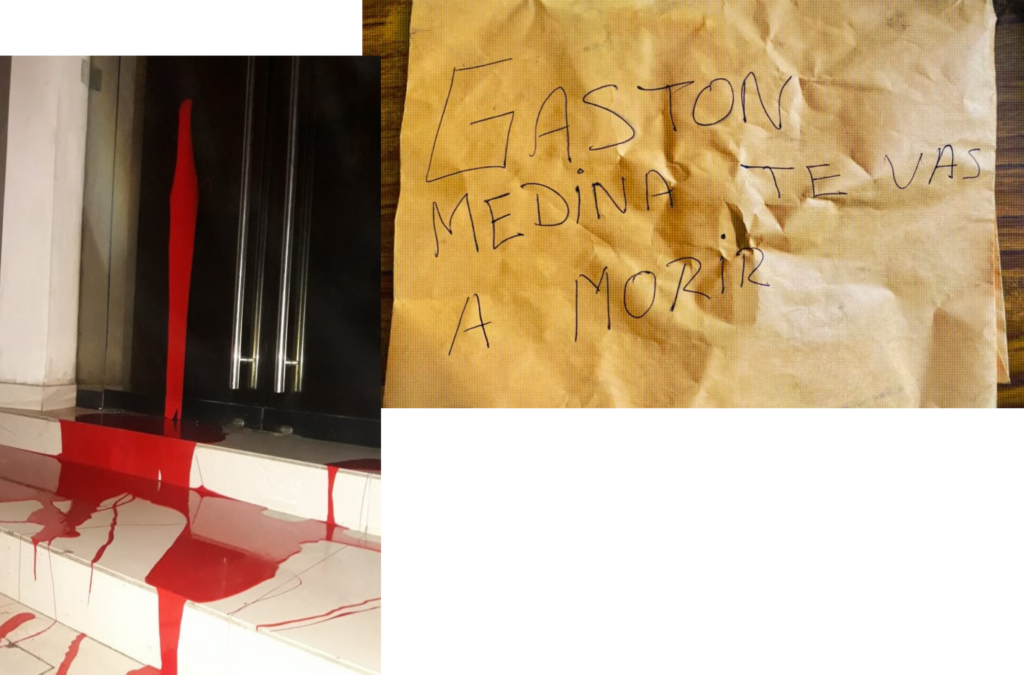
The entrance to the media outlet Cadena Sur covered in red paint (Credit: IPYS) / Threat received: “Gastón Medina, you’re going to die” (Credit: Gastón Medina) / Explosion at the premises of Cadena Sur captured by security cameras (Credit: Cadena Sur).
To protect himself, Medina made the threats he received public rather than reporting them to the police, whom he distrusted. In the months leading up to his death, he considered buying a bulletproof vest, changed his routines and recorded his shows from home: a sort of sanctuary for him, his partner and his young son. “The whole system is corrupt … The only way to shut me up is to kill me,” he told Caico.
Medina was also the target of numerous slander and defamation complaints, filed by those he exposed on his show. “The mailbox was full of letters from lawyers … Sometimes as many as 80 would arrive in a single day,” Caico said. The journalist was a polarizing figure with his own dark side. Described as hot-tempered and sometimes violent, he left no one indifferent.
Medina was convicted of defamation on three occasions. In 2011, in particular, the Peruvian courts handed him a suspended prison sentence and a fine of approximately $3,700, following a complaint by José Luis Elías Ávalos. The congressman accused Medina of unfairly labelling him a “political turncoat” after he had accepted money to support former President Alberto Fujimori midway through his term.
Endemic and rampant corruption in Ica
When Forbidden Stories and Epicentro TV arrived in Ica, surrounded by the desert, the Nazca Lines and the Pisco vineyards, the heat was stifling, and the air thick with exhaust fumes. In the city center, the roar of traffic was punctuated by the incessant honking of cars and motorcycle taxis.
In July 2026, local election campaigns were in full swing. The province was covered with posters and gigantic murals urging people to vote for the various candidates running for mayor and regional governor. Determined to win re-election, former Governor Gallegos — one of Medina’s bêtes noires — appeared smiling on the bright yellow and green advertisements for the Progresemos party, alongside its guard dog logo.
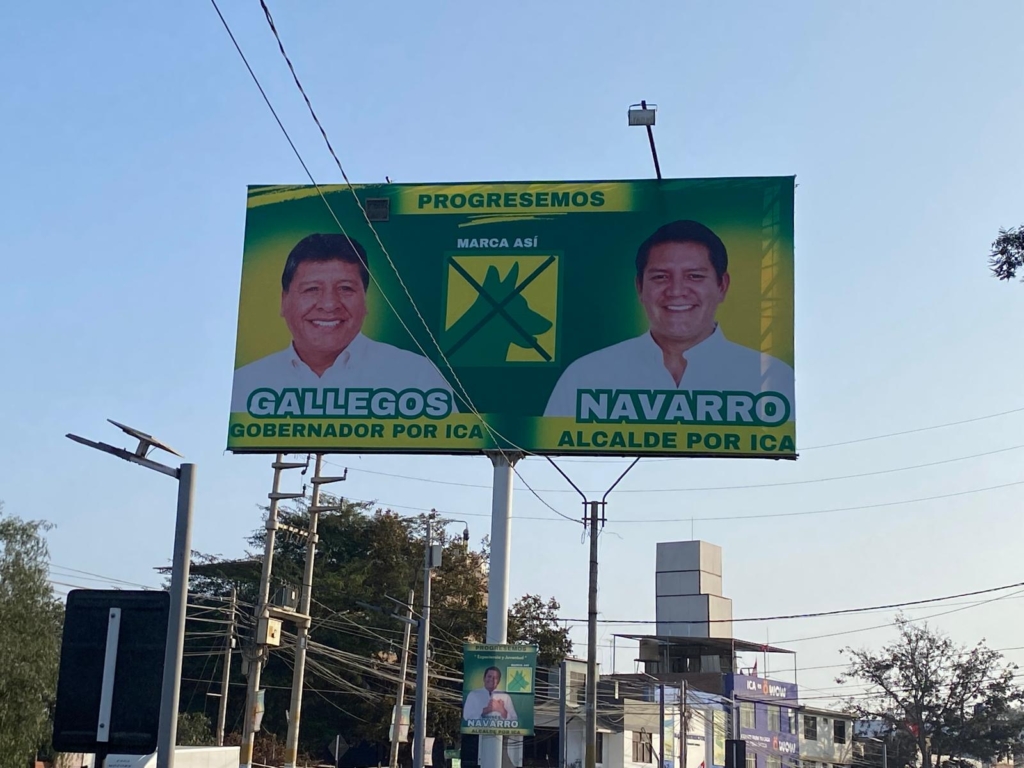
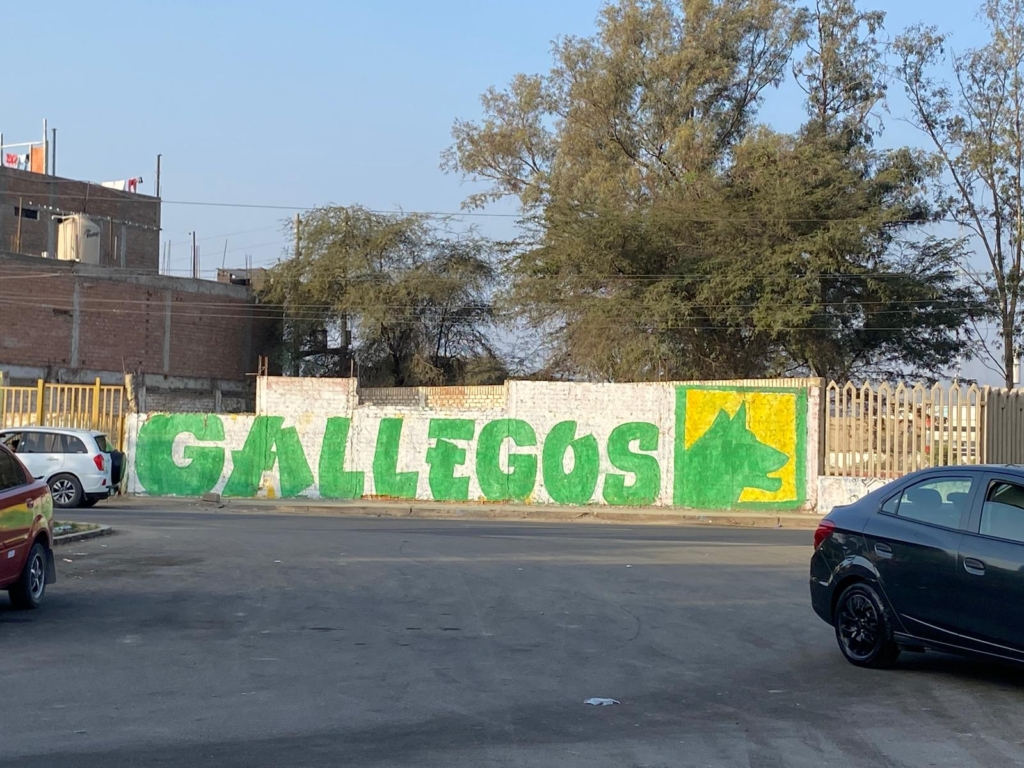
Poster campaigns by the “Progresemos” party in Ica (Credit photo: Emmanuel Colombié, Forbidden Stories).
Ica has a dismal track record for corruption and crime. The Defensoria del Pueblo, an independent institutional body that ensures compliance with the law, estimated that the department accounted for 6% of the country’s embezzlement cases in the first half of 2025. During the same period in 2026, Ica had the fifth-highest homicide rate in Peru out of 25 regions, according to the National Institute of Statistics and Informatics. A significant increase in reports of extortion — 31.3 per 100,000 residents — has only compounded the problem.
Crime has become the primary concern for the people of Ica in recent years. Members of the Tren de Aragua, Venezuela’s most violent and prominent criminal organization, settled in the department as early as 2018 and continue to operate there today.
Forbidden Stories’ reporting took place amid an atmosphere of wariness toward the corrupt press, nicknamed “mermelera” to allude to journalists caught with their hands in the cookie — or “marmalade” — jar. An investigation by Centro Liber revealed that during Gallegos’s term in office, at least 13 journalists in Ica allegedly received irregular payments totaling 500,000 soles — just over 130,000 euros — from the regional government, intended to help spread propaganda and boost the governor’s image. Following the report’s publication, regional government officials threatened and intimidated the director of Centro Liber outside her home.
This same corrupt press, along with an anonymous witness who participated in legal proceedings involving Medina, claims that the journalist was also a “mermelero” paid by Gallegos, despite his widespread denunciations.
Governor Gallegos’s shadow
In his broadcasts, Medina was unflinching in who and what he chose to cover. Nepotism, abuse of power, embezzlement, irregular awarding of public contracts — he was one of the few journalists to bluntly expose these forms of corruption, both at the local and, above all, regional levels.
“Gastón was a thorn in everyone’s side.”
During the COVID-19 pandemic, Medina uncovered a scandal involving the illegal trading of available hospital beds. In 2022, another investigation revealed an illicit scheme to sell driver’s licenses within the regional government’s department of transportation. On the day of his murder, he was investigating the Ica municipality’s purchase of defective garbage trucks.
“Gastón was a thorn in everyone’s side,” said Medina’s attorney, Dr. Wilmer Quispe Pacheco, bitterly. “He stuck his nose into places you couldn’t even imagine.”
Medina’s many years of work and countless hours on the air make it nearly impossible to link his killing to one specific exposé. Nevertheless, he did not merely denounce the rampant crime in Ica; he directly named those responsible.
Among the public figures Medina implicated, several stand out. The first is Gallegos. Though never convicted, he is currently facing 79 legal proceedings, notably for money laundering, and is under investigation by the Lima Anti-Corruption Prosecutor’s Office. In 2023, accused of corruption and membership in a criminal organization, he spent 50 days in pretrial detention before being released under judicial supervision.
Norka Monzón, the regional government’s transportation director during Gallegos’s term, was implicated in the driver’s license scandal and is currently on the run.
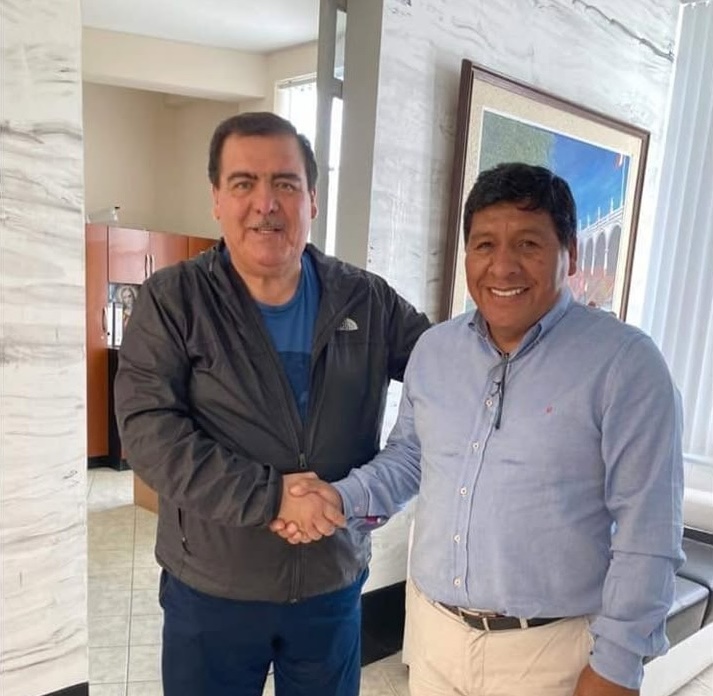
On the left, Governor Jorge “Rocky” Hurtado. On the right, former governor of Ica, Javier Gallegos (Credit: Facebook / La Lupa).
Judge Osmar Antonio Albújar de la Roca, Monzón’s brother-in-law and president of the Superior Court of Justice of Ica from 2023 to 2024, was temporarily disbarred in July 2026 for disciplinary misconduct. He is also the subject of several investigations into corruption and aggravated sexual harassment.
Finally, Jorge Hurtado — nicknamed “Rocky” — has served as governor since his five-year term began in 2022, accompanied by his advisor and right-hand man, Zegarra, against whom Medina waged his final battles.
As soon as Rocky took office, Medina spoke out against Zegarra, who has been accused of overseeing the governor’s office’s dirty work, from favoritism to the embezzlement of public funds. The journalist also did not hesitate to expose the violent incidents Zegarra was entangled in, such as the attempted assassination of a businessman and doctor, César Valdivia Rosales, in September 2022. Rosales claims that Zegarra ordered the attack.
Zegarra’s political maneuvering and ambition got him elected to Congress in April 2026 and sworn in as a member of the Fujimori-aligned, far-right Fuerza Popular party in July.
The investigation remains at a standstill
Nearly two years after Medina’s murder, the judicial investigation has stalled. The alleged perpetrator of the fatal shooting, Pablo Echeverría Suárez, a Venezuelan citizen affiliated with Tren de Aragua, was arrested on May 16, 2025. He is still awaiting trial. Four other Venezuelan nationals, suspected of participating in the murder, have been identified. Three of them have been arrested, including one in Chile. Another remains at large.
Despite the arrest of some of the culprits, the investigation into those who ordered the killing is at a standstill. However, Forbidden Stories and Epicentro TV can now reveal striking details from the court file compiled by the Ica Regional Prosecutor’s Office, based in Pisco.
The documents indicate that Suárez requested in a letter to the prosecutor’s office that Zegarra be summoned to appear and clarify his ties to the case. He recommended that the court question the congressman about the assassination plot broadcast live on Cadena Sur and his whereabouts on the day of the incident.
Perhaps the most important point in this letter is the mention of a suspicious acquisition. In 2022, just two months after taking his position with the governor, Zegarra allegedly purchased an apartment for $80,000. For perspective, the average monthly income in Peru is around $580. Suárez alleges that it was Medina’s revelation of this information that earned him Zegarra’s wrath and led to his murder.
In another unexpected development, Suárez’s attorney, Julio Armando Zuazo Cordova, asked the prosecutor’s office not to take the letter into account, arguing that it had been “drawn up without his authorization.” Reached by phone, Cordova stated that his client had written it without consulting him and suspects that it was “drawn up by a third party.” He further noted that he has not represented Suárez since Nov. 2, 2025, after his inner circle removed him from the case.
These links between Medina and Zegarra remain unconfirmed for now. When Epicentro TV first interviewed him in August 2026, Zegarra claimed that judicial authorities had never summoned him in connection with the case. He also stated that the recordings of his conversation with El Gato were forgeries, citing two private technical analyses he says he conducted independently. He refused to share them when asked.
Medina’s attorney confirmed the existence of a “major legal dispute” between the two men, including defamation lawsuits Zegarra filed against the journalist. He added that the public prosecutor’s office was investigating leads linking Medina’s revelations to his murder in a separate “confidential” case, which Forbidden Stories was unable to access.
Forbidden Stories contacted Zegarra a second time in November. Through his attorney, Juan Carlos Portugal, he replied that he did not wish to comment on a case in which he has not been formally charged. “He was summoned as a witness and gave a statement to the prosecutor. That is our legal position and my client’s official response,” Portugal said.
The Pisco Prosecutor’s Office declined to answer any questions when contacted as part of Forbidden Stories and Epicentro TV’s investigation.

Peruvian President Keiko Fujimori and Carlos Zegarra (Credit: Facebook / Carlos Zegarra Diputado de la República).
While suspicions continue to hang over him, Zegarra has moved away from Ica and now spends part of his time in Lima, under the protection of the party of the new president, Keiko Fujimori. His five-year term as a congressman does not grant him immunity, nor prevent him from being summoned by the courts. But in Ica, the apparent impunity is unbearable for Medina’s family and loved ones, and the journalist’s absence is palpable.
Silence as the only response
Medina’s memory lives on in Ica. The mere mention of his name stirs up fear and intense emotions. Among the sources Forbidden Stories spoke with, some agreed to meet for only a few minutes in the middle of the city’s crowded central square. Another came to the interview wearing a bulletproof vest. Still others backed out at the last minute, fearing they would become too closely entangled in this explosive case.
The same uneasy atmosphere prevailed among the lawyers Medina’s partner Caico consulted. “I can’t take on the case because I have children, a family,” one of them told her. “We know who’s behind all this, but no one wants to get involved.”
Life has completely changed for Caico. “I had to find a way to protect myself and invest in my own safety,” she said. “I don’t trust the government or the local authorities.”
Medina’s friend Pepe echoed the sentiment. “Everyone in Ica and Peru has forgotten him. Every month, we strive to remind people of the importance of his work. We have such a corrupt judicial system. Here, money silences a lot of things,” he said.
For journalist Hernández, who worked alongside Medina for 26 years at Cadena Sur, “Gastón’s work was well-researched and evidence-based; that’s why it carried so much weight,” she said. “No one can take that away from him; he was a journalist who mattered … And the void — the void he left in the Peruvian media world — is immense.”
*Name has been changed for security reasons




Leave feedback about this