By Estacio Valoi and Luís Nhachote (CJI — Part 3)
What is happening in Vilankulo is not an isolated case. It is the local manifestation of a broader economic model — repeated over decades in different regions of Mozambique — based on the concession of natural resources to foreign investors, with the promise of rapid development and structural transformation of the territory that ends up yielding no benefit, and those in control are the multinationals, who always take 75%! The house is handed over, sold for a song for the benefit of the few!

Watch the video:
Amidst nepotism, alleged corruption, a mining company backed by the current government, without an environmental licence—a prerequisite for commencing operations under Mozambican law— and an EIA is required to secure this licence, violation of community and workers’ rights, with no community consultations or, where they do exist, no public participation, Vilankulo Inhambane has continued to push ahead with frenzied exploitation for three years, with the final endorsement being the launch of the petrochemical city in 2025 by the current Mozambican president, Daniel Chapo. “Haiyu… it’s all under the same corporation”.
The parent company could be Great Wall Mining Development Co (AGWMDC), a Chinese mining company that extracts heavy sands (ilmenite, rutile and zircon).
https://www.cipmoz.org/wp-content/uploads/2024/04/Extractivism-which-destroys.pdf
Mozambique’s heavy sands, rich in dense minerals such as ilmenite, rutile and zircon, are mined to extract titanium and zirconium, materials that are essential in the technology, aeronautics, pigments, paints and ceramics industries. They are also crucial in the construction industry for high-strength concrete, and in the manufacture of paints, plastics, paper and ceramic components; and Metallurgy: Production of high-strength metals, such as titanium: Essential for structural concrete, slabs, paving, drainage and the manufacture of refractory bricks, they are mainly exported to major consumer markets, Asia (mainly China), Europe and the United States, according to monitoring data from the extractive industry, which is currently concentrated in areas such as Nampula, Zambezia and Chibuto (Gaza), involves Chinese companies, and is frequently transported via the Port of Maputo.

Watch the video:
The rapid expansion of the Haiyu group in Mozambique
From 2019 to 2025: In less than six years, the Haiyu group, believed to be majority-owned by Chinese capital, has established a network of mining companies in Mozambique, spread across the provinces of Nampula and Inhambane. Commercial documents obtained and analysed during this investigation reveal a consistent pattern: multiple subsidiaries, almost identical corporate structures and centralised control from foreign entities. The CJI’s analysis is based on 17 commercial certificates, statutory amendments and administrative records, enabling the reconstruction of the group’s trajectory from its entry into the country in 2019 to its recent reorganisation in 2025.
The geographical expansion of the Haiyu group’s operations in Mozambique coincides with areas where the current President, Daniel Chapo, previously held administrative posts. Chapo was district administrator in Nacala-a-Velha (2009) and Palma (2015), before being appointed Governor of Inhambane Province in 2016, a post he held until his presidential candidacy in 2024. Some of the areas where the group has established mining operations are located in these same regions or in areas under his former administrative jurisdiction. To date, there is no public evidence establishing a direct link between the official and the group’s operations. However, the geographical overlap raises pertinent questions about the institutional context in which these concessions were awarded.
Rapid and structured expansion

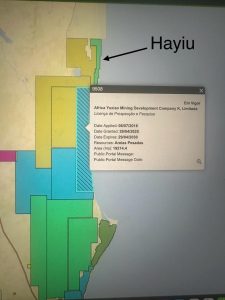
The first records of the Haiyu Group in Mozambique date back to 2019, with the incorporation of its first companies involved in mining. Since then, the number of companies associated with the group has grown steadily, in line with a strategy of territorial expansion.
The companies identified are mainly concentrated in two regions: in Nampula, with several entities under similar names, and Vilankulo (Inhambane), where the group has also established a presence.
Among the companies analysed are:
Haiyu (Mozambique) Mining Nampula I, II, III
Haiyu (Mozambique) Mining Nampula X, SU, Lda
Haiyu (MZ) Mining – Vilankulo
Haiyu Vilankulo Mining Co., Lda
The repetition of names and structures suggests a pattern of operational replication, frequently observed in groups with extractive activities across multiple concessions.
A recurring model
The documents analysed in minute detail by the CJI indicate that the various companies follow a virtually identical corporate model. Generally, the capital structure consists of: i) a majority entity holding around 90% of the shares, linked to the Chinese company Hainan Haiyu Mining Co., Ltd, and ii) a minority stake of around 10%, associated with entities registered in Hong Kong.
This model is repeated across several companies, suggesting a centralised organisation, despite the multitude of formally distinct companies. According to the records, effective control of operations remains concentrated in the Chinese entity.
The same names, various companies
Another pattern identified is the repetition of directors across the different companies. Among the names that appear frequently are: Hefeng Dong, Juyi Li, Li Zhou and Zhou Li
The recurring presence of the same directors in various companies may indicate strategic coordination and centralised management.
Recent changes and reorganisation
From 2024 onwards, the documents point to significant changes in the group’s structure in Mozambique. Among the changes identified are: share capital increases, amendments to the articles of association and the creation of new entities, including a sole proprietorship. In 2025, this development culminates in an apparent reorganisation of the group, with the introduction of new legal structures.
According to the documentary analysis, these changes may be linked to internal restructuring, adaptation to new concessions and asset segmentation.

Geographical expansion and resources
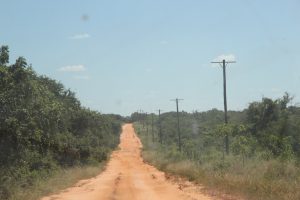
The simultaneous presence in Nampula and Vilankulo suggests a strategy focused on coastal areas with mineral potential. Although the commercial documents do not directly detail the concessions associated with each company, the geographical distribution and sequential establishment of companies indicate a possible link to the exploitation of specific resources.
Patterns that raise questions
An analysis of the records does not, in itself, reveal any documentary irregularities. However, several factors warrant closer scrutiny: the sequential establishment of multiple companies with identical structures; the concentration of control in foreign entities; the systematic repetition of directors; and the use of intermediary entities registered in Hong Kong
These patterns are consistent with complex corporate structures used in international operations, particularly in sectors of high economic value.
At the heart of all this lies a question rarely asked directly: who decides the fate of these territories? Projects on this scale are not defined at the local level. They result from negotiations between the state, investors and technical bodies, often far removed from the communities that will live with the consequences. By the time information reaches the ground, the essentials have already been decided. The scope for participation becomes limited — and, at times, merely formal.
Vilankulo thus becomes a focal point for various tensions: between the short and long term, between economic growth and sustainability, between national interest and local impact, between promise and reality.
The Inhambane coast stands today at a crossroads. It can consolidate a model based on conservation and tourism, integrate fully into a global extractive economy, or attempt to reconcile both — a task which, in practice, has proven profoundly difficult when interests clash directly.
Heavy sand mining fits this pattern perfectly. Long-term concessions, a strong presence of foreign capital, the export of raw materials with little local processing, and benefits concentrated outside the communities directly affected. The rhetoric accompanying these projects is familiar: job creation, boosting the local economy, increased revenue for the state. But the central issue is not what is promised. It is what remains afterwards.
On the ground, the initial effects are already visible. Mining does indeed seem to create the promised jobs, particularly in the early stages, absorbing the local workforce in a context where opportunities are scarce. For many young people, it is the only immediate source of income. But this effect is short-lived. As the project progresses, mechanisation tends to increase, the need for manual labour decreases, and the more skilled roles are often filled by external technicians. The cycle repeats itself: rapid job creation, followed by a gradual reduction in employment and the concentration of value outside the community.
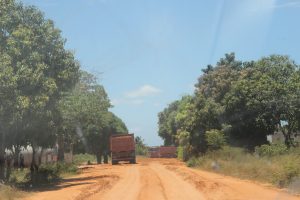
At the same time, infrastructure begins to take shape that goes beyond the scale of local extraction. Plans for ports, roads and logistics corridors emerge as natural extensions of the mining project. Even when they remain at the conceptual stage, they reveal the true scale of the intervention: it is not merely a matter of extracting sand, but of integrating the coast into a global chain for the export of resources. The landscape is no longer defined by its ecological or tourist potential but is organised according to logistical efficiency.
This process raises a structural question: what proportion of the wealth generated remains in the country — and, above all, in the communities directly affected? Experience accumulated in different contexts suggests a consistent pattern. Most of the value is captured elsewhere — in industrial processing, distribution chains and international markets. Locally, there remain limited jobs, tax revenues often reduced by incentives and exemptions, and concentrated environmental and social pressure.

The problem is not merely economic. It is one of distribution. It is a question of the model itself!
Before the expansion of large-scale extractive projects, other possibilities were discussed for the Inhambane coast. Models based on environmental conservation, sustainable tourism, the so-called blue economy – which the government appeared to advocate as recently as May 2026 – and even international financing mechanisms linked to ecosystem protection. These alternatives were based on a different logic: enhancing the value of the territory over time, whilst maintaining natural capital as a strategic asset. The choice of the extractive route represents a profound shift — replacing a model of gradual income generation with one of intensive and accelerated exploitation.
For local communities, this transition is not theoretical. It is experienced in daily life. On the one hand, there is anticipation: jobs, the circulation of money, the promise of development. On the other, uncertainty grows: loss of access to land, changes to ways of life, environmental degradation and a lack of clear guarantees about the future. The speed of change often outstrips the capacity for social and institutional adaptation.
As is the case with other projects involving multinationals, consultants are paid to approve it and the communities are left high and dry.
From our local sources and documents: “The Ministry of the Environment rejected this project. There are the documents submitted by the mining company: their Environmental Management Plan, the Environmental Impact Assessment Report, and all of this was rejected by the Ministry of the Environment. And to reject it, they relied heavily on this report, which is the analysis of potential environmental impact. So, in 2019/2020, it was rejected.”
The abuses continued, and one of the local organisations, referring to the report that rejected the mining company’s project, said: “There is a lot of technical information in that report explaining why this cannot be done either. When the report was submitted, everyone realised it was used internally within the Ministry; it wasn’t published anywhere, it was used for internal assessment by the Ministry of the Environment’s team. The report shows that we also did everything – studies here on the reefs – because what we’re trying to demonstrate is the importance of this ecosystem.”
Complaints about the construction of the port and the exploitation of sensitive areas

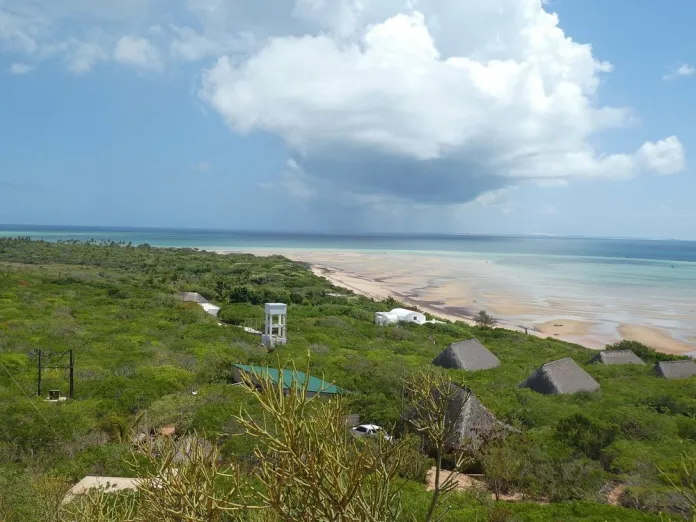
Video: Area where the HYM intends to construct the port
According to Gabureza, in Vilanculos there were complaints that even required the administrator’s intervention to resolve, but, “shortly after the launch of that project (the petrochemical city), there with the President of the Republic, we only saw the Chinese bringing in staff, and right now, this very week (15 February 2026), they are hiring en masse. There have been many attempts by the company to consult the community, the business sector, tour operators, environmental civil society organisations, as well as others consulted about where they can build, and the response was simple. “We don’t want the port built here.”
He adds: “Here, in terms of the community, it is the village chiefs who go and meet with the heads of the administrative posts and districts, and they are receiving instructions. And there’s an area there they call the plain, and what makes me suspicious is that it’s that mangrove area they call the estuary plain; I suspect that’s the very spot they’re planning for the port. And the communities have been told that nobody should do anything or plant anything there because a residential area is going to be built there. A residential development in the mangroves! It makes no sense! I think it’s a plan to keep people away. And then they say, “Because there’s an old road here, closer to the coast, linking Massinga and Vilanculo,” which before the 16-year war was supposed to be the main road, and when the war started it was abandoned, but now they’re talking about reactivating and reopening that road to provide direct access from here to the airport, for these businessmen. There have also been meetings about building an airstrip in this area of the mines, in the mangrove swamp; it is these discussions that are reaching local leaders, stemming from meetings at district level. “Said Gabureza
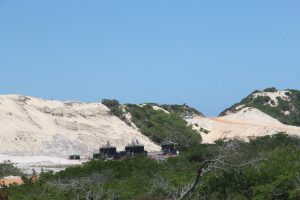
Malagueta Jesus confirms that the company, without an environmental licence, has been operating for three years. “They have impressive equipment and vehicles; even before the mining licence was granted, they were already extracting the ore clandestinely, and our coastline is poorly protected. You get 60% or 70% because you’re the one who’ll be operating it; I get 40% in the office. At the end of the day, you don’t know how much your partner is taking. I mean, he’ll take whatever suits him. Those dunes are important for the ecosystem.”
One of the local organisations we spoke to points out that there are alternatives to the supposed dollars from Haiyu that will leave Mozambique riddled with craters stretching for kilometres
“The impression we get is that the mining company holds meetings at the highest levels of government; they send instructions to district leaders, leaders and their circles; you can see they have no idea of the scale of this. They just say: ‘Hey, there’ll be a road, there’ll be this.’ They’re employing people, but it’s slave labour: working non-stop, carrying stones, operating the machinery, digging up bags, and if you don’t want to work, there’s someone else. And it’s for young people. And right now, young people are fighting amongst themselves, in desperation. As there are no jobs, those crumbs are a lot. So, everyone is seeing this as a lifeline, but no one knows there’s an alternative on the table. First there was the Debt-for-Nature Swap alternative, which are financial schemes where a country swaps its foreign debt for a major investment to protect critical ecosystems of global importance. So, this stretch of the Inhambane coast is internationally recognised as a unique piece of marine and coastal landscape.
He adds that two years ago, or a year and a half ago, there was a Debt-for-Nature Swap proposal – the one currently operating in Ecuador to protect the Galápagos – which was presented to the government: “We will forgive around 700 million dollars of external debt, and you will still receive a hundred-odd million dollars in an Endowment Fund to implement programmes in this area.” In other words, investing in the government itself, investing in the organisations that work with the communities themselves. The source emphasised

“The government doesn’t want any alternatives!”
“Yes, because that scheme doesn’t put money in people’s pockets, but it does put money into the state coffers and the Endowment Fund, which would continue to provide funding as long as it continued to protect community business development whilst preserving resources. The fear this instils is, in a way, somewhat reminiscent of Cabo Delgado: we have many young people with few alternatives, who are desperate! Now, at the start, it’s easy to hire local people to build roads, do small-scale construction work, carry sacks! But when the opportunities start – even for providing services or hiring skilled technicians – almost everyone will come from China. And if they’re nationals, they’ll probably come from Maputo, won’t they? And these people will likely have to be displaced from where they are. Yes, they’re in favour of this because we have no other way of making a living; this is to prevent an environmental disaster, because here we have unique reef systems, unique species routes, and people live off fishing.
“What’s going on now?… Nobody here lives off SASOL.” https://moz24h.co.mz/vilanculos-say-no-to-oil-and-gas-say-no-to-seismic-testing-protect-bazaruto/ .
Inhambane at risk of disappearing.
In Vilankulo, they’re plundering almost everything; they want it all, from the ground up to the seabed!
“We don’t want seismic surveys…”
Watch the video: Gabriel Cossa, community member/businessman/Vilankulo
More than an economic choice, this is a choice about the kind of development the country wishes to pursue. A path that prioritises intensive extraction may generate quick gains, but it puts at risk the very natural systems that sustain other forms of wealth. A path based on conservation requires more time, more coordination and more patience — but tends to preserve value across generations.
The case of the heavy sands in Inhambane illustrates this tension particularly clearly. Ultimately, the question is not just who gains today. It is who will continue to gain tomorrow — and at what cost? Because, once the sand has been extracted, once the ecosystems have been altered and once the extraction cycle has ended, one inevitable question will remain: What is left — and for whom?