New investigations and analysis from ZAM and our network.
 |

In this edition of the Kleptocracy Report:
- Editorial: Standing by repression victims
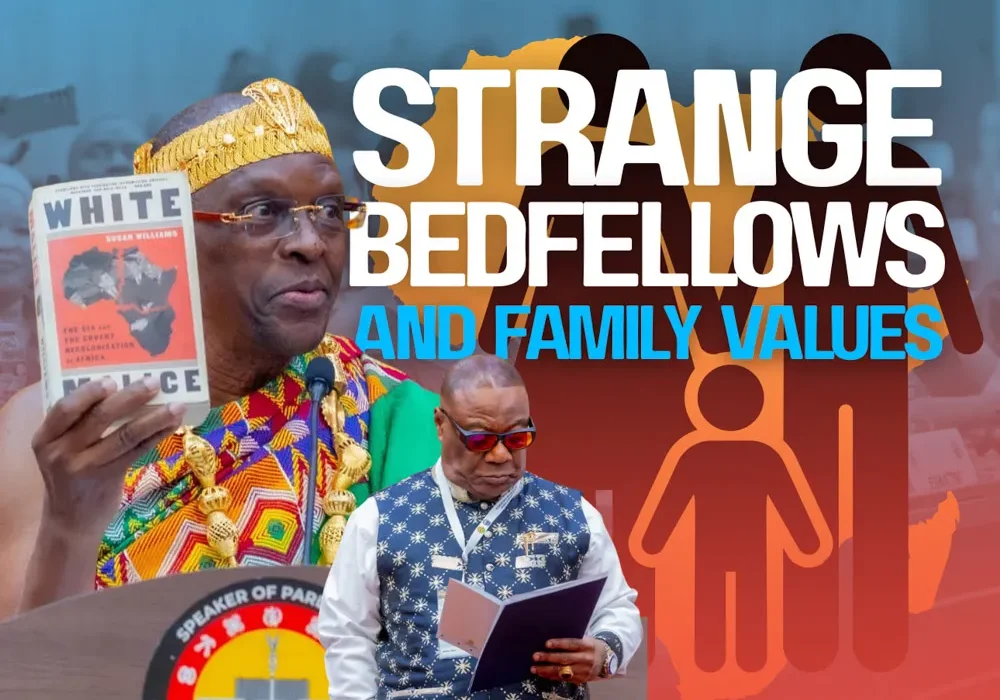
- Strange bedfellows and their family values
- Nigeria’s wasted trillions
- The Burkina Faso mirage
- Trapped in Silicon Savannah
- And more stories from the network!
Editorial
Standing by repression victims
As European support for pro-democracy forces in Uganda is scaled down and Western “security cooperation partnerships” with President Museveni’s kleptocracy continue to thrive, little bits of money from Uganda’s citizens, sent via mobile phones to activists, make a difference.
“Some contributions have been of the equivalent of only 3 dollars”, says Agather Atuhaire of the human rights and social justice platform Agora. “But in the end we raised all that was needed and more.” The recent case in question was a US$ 10,000 defamation conviction levelled by the Ugandan state against fellow activist Jim Spire Ssentongo, a respected academic as well as a satirical cartoonist with large online following. Spire had exposed shenanigans at a politically connected private university that was cheating students -including the academic’s own two nephews- out of fees and its workers out of benefits. But the university’s chairman had high-level ruling party friends and the defamation verdict came swiftly, in spite of Spire’s platform posting evidence to substantiate the claims. Atuhaire: “The money transfers were accompanied by comments saying that “we are standing with those who raise our issues on their public platforms.”
It is not the first time that Agora and Atuhaire organise crowdfunding from the Ugandan public. “We have done campaigns to pay bail for political prisoners, for medicine and food for those who are still in jail, and for the mother of Sam Mugumya, who disappeared. The mother is left not only without a son but also a breadwinner.”
She admits that it is “painful that our government is sitting on so much wealth”, while activists have to organize themselves around pennies. A special headache is the government’s recent closure of activists’ bank accounts and its new laws against foreign funding, which make it difficult to receive support from abroad.
“But it’s heartening to see that so many Ugandans want to help victims of the repression, and that they have so much trust in us as Agora. People are so fed up. They show us that they stand with those who are harassed because they raise issues of public interest. This repression is creating solidarity.”
We produce the Kleptocracy Report with a small team of African investigative journalists. Your support can help us to keep publishing in freedom and open gateways for democratic change. Read more about our work and funding here. And please also comment, and contribute kleptocracy news for us to look at!
Strange bedfellows
 |

Image ZAM
Last June, leaders from some of Africa’s most repressive countries dominated a pan-African “Family Values” conference in Accra, Ghana. While they pushed policies aimed at keeping “confused youth” under the authority of “chief and church”, they also emphasised autocrats’ “sovereignty” over Africa’s “abundant mineral wealth”. Behind the scenes, their Trump-aligned Christian nationalist allies in the USA were cheering them on -and doing deals.
Nigeria’s kidnap trillions
 |

Image courtesy of Andrew, sourced through Flickr. CC Licensing.
Much of Nigeria’s security budget is spent on high-end fighter jets to be used against a yet to be determined foreign enemy. Meanwhile, domestically, organised crime and terrorist syndicates roam free on the country’s highways, abducting people for ransom in towns and villages. Mistus Elordie investigated the country’s budgetary priorities as well as its management of the security crisis.
Decolonising Burkina Faso
 |

Image ZAM
To many young Africans online, Burkina Faso’s leader Captain Ibrahim Traoré represents the hope of African governance free from the influence of extractive foreign and neo-colonial powers. His speeches and messages reflect laudable revolutionary measures, such as the nationalisation of resources. But is the country really decolonising?
Trapped in Silicon Savannah
 |
Background image by Robynne O. Sourced through Unsplash.com and Canva. Image modified.
Many tech firms recruit content moderators and other personnel from across Africa to work in Nairobi, the continent’s “Silicon Valley”. But dodgy contracts and residency issues can leave migrants stranded. OpenDemocracy investigated the death of Nigerian Ladi Olubunmi.
Read Tech’s Deadly Recruiting Ground
Stories from the network
- Billions allocated to primary health care in Nigeria seem to vanish into thin air. A Premium Times investigation recorded dilapidated buildings, scattered patient records and little, if any, services.
- Zambia’s recent elections came with at least one murder. Makanday investigated. See their story here.
- Malawi’s aircraft safety system is faulty and leads to at times catastrophic mechanical failures, our partners at the Platform for Investigative Journalism found.
- Journalists across Europe found themselves in online databases. The Committee to Protect Journalists produced a comprehensive report report on shocking evidence showing that none of us escape mass surveillance.
ZAM works with investigative reporters in African countries to bring you this content. Please subscribe, preferably paid, to support and enable more ZAM and NAIRE Kleptocracy Reports. Also: do comment and send us alerts to news we should be aware of!
Thanks for reading The Kleptocracy Report by ZAM x NAIRE. Subscribe to receive new posts and support our work.
You’re currently a free subscriber to The Kleptocracy Report by ZAM x NAIRE. For the full experience, upgrade your subscription.