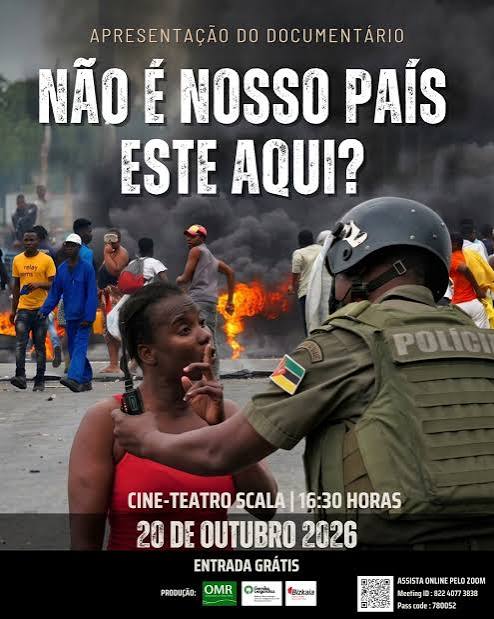
The treason trial of Venancio Mondlane is claiming to ask who is responsible for the violence in the post-election demonstrations. The answer from ordinary people filmed in demonstrations and interviews is in the banned OMR film “Isn’t this our country?” (Nao e nosso pais este aqui?) The 45 minute film is particularly good in recording both the power people felt in the demonstrations, their disempowerment facing the damage done to their lives by mining, and the powerlessness faced by young people with no jobs and no future.


The film makes clear how the subsequent demonstrations and actions were decided locally in cities and towns across the country. It also makes clear the anger of ordinary people at what they see being done to them, and about their lack of power to respond.
The film does not hide the reality, and shows at least two people actually being killed by police, including journalist Mano Shottas shot livestreaming a protest on Facebook in Ressano Garcia.
Showing of the film in Mozambique is blocked by a state agency saying it was filmed without a licence, when the law specifically applies only to commercial filming and not research institutes like OMR (Rural Observatory). But it is obvious why Frelimo is anxious that it not be shown during the treason trial – it tells a very different story from the one being told in the courtroom. It gives Mozambicans a voice in their own country. (I am out of Mozambique and was allowed to see this excellent film. There is a subtitled version.)
For Portuguese readers, the two OMR people responsible for the film, Joao Feijo and Rita Chiure, have also written two important research papers going into these issues more deeply, Observador Rural 172 and 169 https://omrmz.org/observador-rural/
Mondlane trial daily reports
In contrast to previous major trials, there is excellent English reporting of the Venancio Mondlane treason trial, which began Tuesday 17 November. Thus we are not doing our own reporting, and offer this set of links, all in English, daily, and all free.
CDD https://bit.ly/Moz-trial-CDD Centre for Democracy and Development, which has a journalist in the courtroom. Its reports are normally available only in its newsletter, and we are posting them on our website with permission.
LUSA (Portuguese press agency which has a journalist in the courtroom, with multiple articles daily) and its reports are posted free in English by Club of Mozambique – Politics https://bit.ly/Moz-trial-Club. Club also posts material in English from Evidências, TV Sucesso, and other media.
AIM (state news agency, has a journalist in the courtroom and includes a report in its daily news summary) https://bit.ly/Moz-trial-AIM
Mozambique Times (Independent newsletter with journalist in the courtroom) https://bit.ly/Moz-trial-MozTimes;Mozambique Insights has commentary in English www.mozambiqueinsights.com
To subscribe or unsubscribe: https://bit.ly/Moz-sub
This newsletter is distributed on DEV-MOZAMBIQUE@jiscmail.ac.uk.